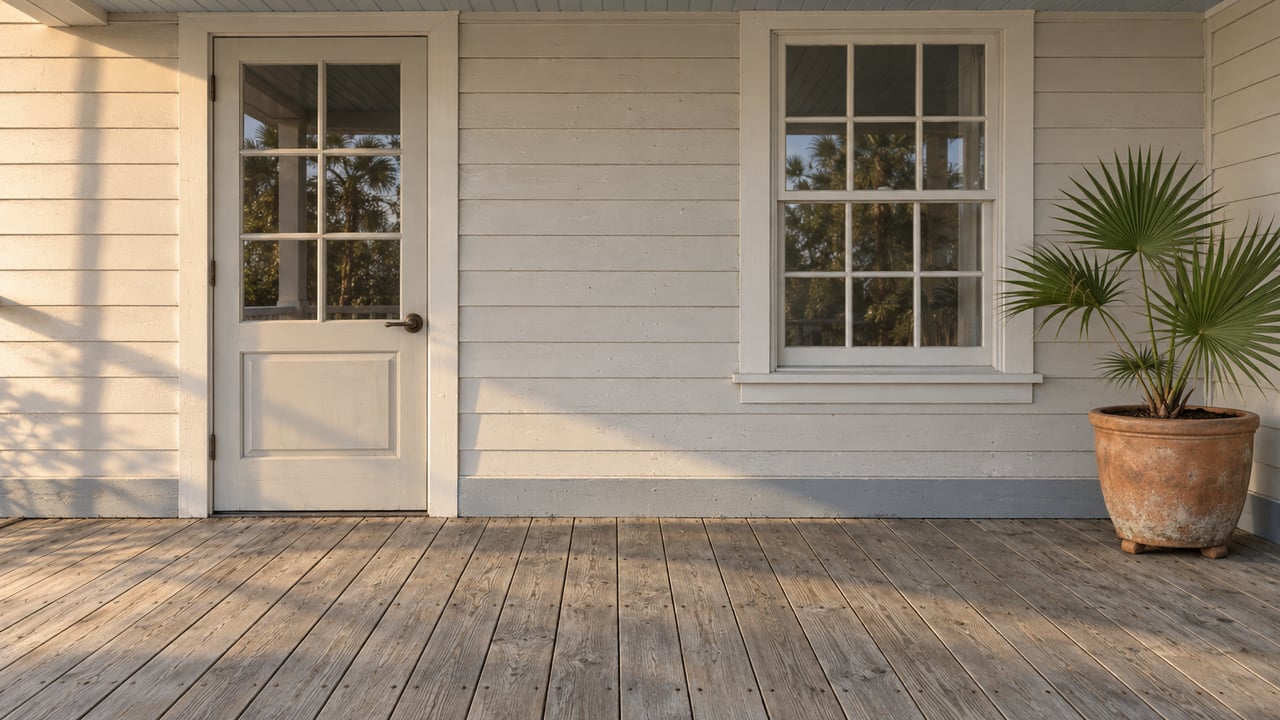
The Material Under Your Feet at Station 22 Is Still Being Decided
October 29, 2026
October 29, 2026
Until this year, getting to the sand at Station 24 meant crossing plywood. Floodwater had rotted much of the old boardwalk's understructure, and the boardwalk slumped into the wetland between the dunes. Boards were laid over the mud to cover the gap between where the walkway began and higher ground, according to the Town's October newsletter. The replacement is a six-foot-wide walkway with composite decking. It is 960 feet long: about 700 feet of rebuilt boardwalk, plus 60 new feet at the north end and 200 at the south, according to the Town's bid documents.
Station 24 is one of sixteen beach access boardwalks on the island, and some of them went in twenty-five years ago. They are being replaced one at a time, and each replacement sets a path's material and shape for the life of its structure. Station 22 is next. Station 24 used composite, and this fall's public record shows the island reconsidering that choice for Station 22.
The Town paid for Station 24 with Charleston County Greenbelt funding. It hired an engineer to design the job and oversee demolition and rebuilding, according to the Station 24 project page. The bid schedule expected work to start in the first quarter of 2026. The September 2026 Resilience and Natural Resources report to Council says the final walkthrough raised concerns that delayed completion. It describes the corrections as minor and says the boardwalk will stay open during the repairs.
The newsletter says the Town's replacement assessment accounts for rising floodwaters, so some boardwalks will need to be extended, not just replaced. It names Station 24 as the prime example. That reasoning carried straight into the debate over Station 22, along with a question Station 24 never had to answer in public: what the deck should be made of.
Staff presented a conditions assessment of the public boardwalks at the May 7 Public Facilities Committee meeting. In the discussions that followed, Station 22 "emerged as a top priority for replacement," according to the staff report by Rebecca Fanning of the Planning, Building, and Resiliency Department in the Oct. 20 Council packet. The same report lists the votes along the way:
The Station 32 application was later canceled, and its allocation went back into the pool. That is why the figure now available for Sullivan's Island boardwalk replacement and extension is $79,385, more than staff had previously reported. Staff recommended replacing 470 feet and adding a 280-foot extension to protect the foredune.
Station 22 differs from most island access points in one way. An emergency vehicle path already cuts through the dunes beside it, as one resident's comment in the Sept. 15 packet points out. Some residents wanted the boardwalk replaced. Others wanted the existing gravel emergency road widened for both pedestrians and emergency vehicles, according to the staff summary of public comments.
Staff took those options to the state's Bureau of Coastal Management in preliminary talks. Replacing or extending the boardwalk could go ahead without a permit. The bureau would even waive the usual rule that the boardwalk sit two feet above grade, because of concerns about pedestrians stepping onto it from the emergency road next to it. Removing the boardwalk and widening the road would require a Major Permit. Raising the roadway would also need a Major Permit, plus hydrologic and hydraulic modeling. Dune fencing and native dune grass at the foredune could be handled under a Minor Renourishment General Permit.
Greenbelt money can pay only to replace or extend boardwalks, so choosing the road would also have taken the $79,385 off the table. Permitting and funding both favored the boardwalk Council approved in September.
The Sept. 15 packet framed the deckboard choice as Black Locust or composite, and it does not record a selection. Public comments have mostly asked for natural materials, especially Black Locust. At least one comment favored composite because it lasts longer. One letter in the Oct. 20 packet says Council directed staff to look at two products: Black Locust wood and Moisture Shield, the composite used at Station 24.
The claims below come from residents' letters in the Council packets. They are positions submitted for the record, not Town findings.
Point raised | Black Locust | Composite | Source in the record |
|---|---|---|---|
Surface temperature measured on the same hot day | 126°F, existing Station 22 wood | 148°F, Station 24 composite | Resident letter, Oct. 20 packet |
Fire spread rating cited | Class A | Class C | Resident letter, Oct. 20 packet |
Expected life against a 25-year structure | Predicted to exceed it, per Town staff | Predicted to exceed it, per Town staff | Resident letter, Sept. 15 packet |
Track record on the island | New material for the Town | The writer says some recently installed synthetic boardwalks have already shown failures | Resident letter, Sept. 15 packet |
The Sept. 15 letter also suggests bidding out both planking options so the Town can learn the actual cost difference, if any. That letter's point about lifespan explains why this decision matters more than it might seem. Pilings and joists have a 25-year useful life. If both deck materials outlast that, then whatever goes on Station 22 now is what people will walk on until the whole structure is due again.
The Oct. 20 agenda asked Council to authorize staff to submit a Notice of Intent and an application for the $79,385. In September, staff planned to submit the application in November. Neither packet sets a total project cost, a construction calendar, or a closure plan for the Station 22 access.
On the Town's schedule, the next public sessions are a Council workshop on Monday, Nov. 2, and a regular Council meeting on Tuesday, Nov. 17, both at 6 p.m. at Town Hall, 2056 Middle Street. The Town's meetings and agendas page says agendas go up 24 hours before each meeting. The Town also holds a monthly Coffee with a Council Member at Town Hall from 8 to 9 a.m., an informal setting where any topic is open.
The Ben Sawyer Bridge, the island's link to Mount Pleasant, is running under limits of its own this fall. The bridge was built in 1945, and Hurricane Hugo heavily damaged its swing span in 1989. A $32 million rehabilitation in 2010 kept its historic look and improved pedestrian access, according to the Town's transportation page. On Oct. 19, the swing span failed to lock into place, The Post and Courier reported. As of Oct. 21 it was open to regular traffic, emergency vehicles and school buses. The paper reported that trucks over 13,000 pounds are barred until a permanent repair, and Police Chief Glenn Meadows directed those trucks to the Isle of Palms Connector. WCBD described the limit as the posted 13-ton restriction and reported that SCDOT had not given a timeline.
Boat traffic feels the biggest change. Under federal drawbridge rules, the bridge normally opens on signal. The exceptions are weekday rush hours, 7 to 9 a.m. and 4 to 6 p.m., and weekends and federal holidays, when it opens only on the hour between 9 a.m. and 7 p.m. Live 5 reported on Oct. 22 that the temporary schedule allows openings only at 10 a.m., 2 p.m. and 7 p.m. Each can last up to 25 minutes, compared with the usual 10 to 12, and Meadows called the situation fluid. Check SCDOT before planning a crossing by boat or truck.
The rest of the fall calendar runs on the island's usual rhythm:
Owners who spend the winter away still have a stake in how the Station 22 decision turns out. Handsome Properties follows these Council sessions as part of caring for island homes, and our absentee-owner program's weekly on-site checks keep you informed about your street and the paths near it between visits.
Handsome Homes
Transforms property buying and selling into a thoughtful, curated, and highly personalized experience, expertly tailored to Charleston’s luxury, historic, and exclusive real estate markets.