The Line Street Divide: Why Two Historic Charleston Homes Don't Play by the Same Rules
August 27, 2026
August 27, 2026
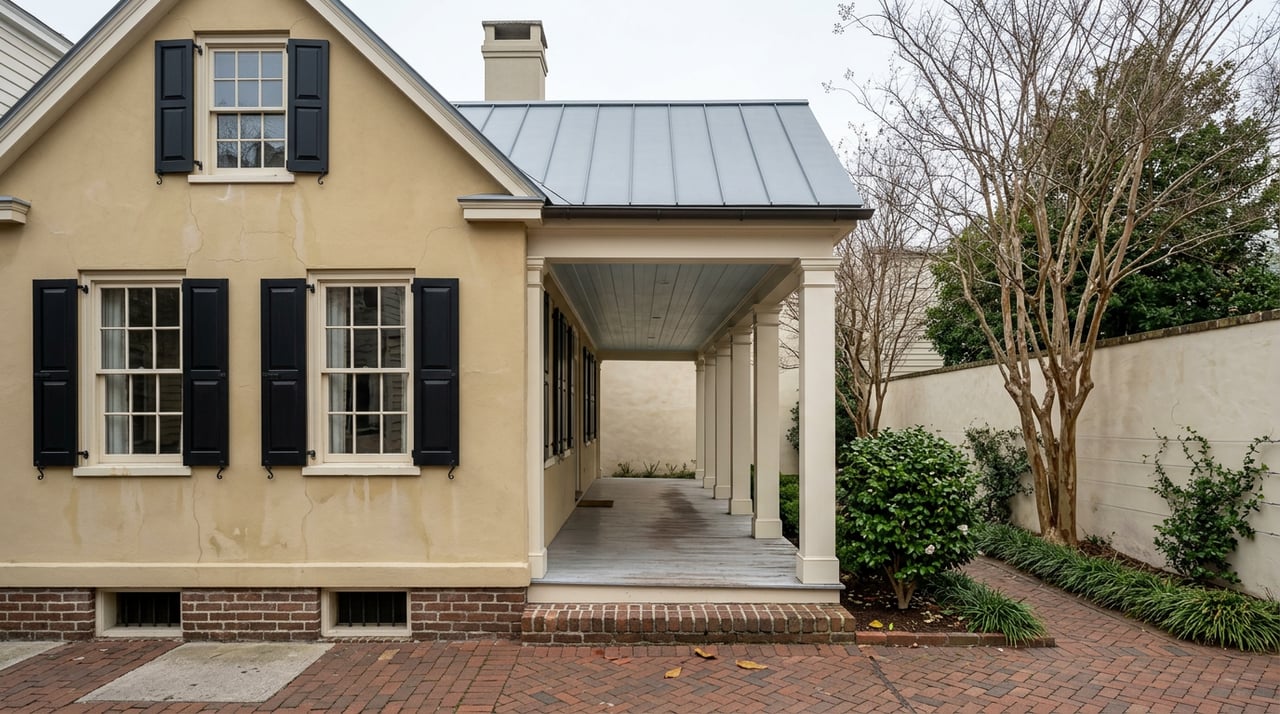
On April 9, 2026, the City of Charleston's Board of Architectural Review worked through one of its small agendas, and two items on that list tell you almost everything a buyer needs to know about shopping for a historic home here. At 29 Chalmers Street in the French Quarter, an 1884 house rated Category 4 needed conceptual approval from the board just to add a new stair. Across town at 61 Gordon Street in Wagener Terrace, a 1940 house carrying that same Category 4 rating also came before the board that day, but only because it had already undergone a partial demolition of exterior elements. The board wasn't asked to weigh in on what would replace what came down.
Same category. Same city. Same regulatory body. Wildly different amount of scrutiny.
The difference has nothing to do with the houses themselves. It comes down to which side of Line Street they sit on, and that single geographic fact does more to determine what you can and can't do to a "historic" Charleston property than the age of the house, its price, or even its official architectural rating.
Charleston created the country's first local historic preservation ordinance in 1931, and the Charleston Historic District it protects became a National Historic Landmark District in 1960. The Board of Architectural Review that grew out of that 1931 ordinance still splits its work into two committees, BAR-Large for major projects and BAR-Small for everything else, meeting roughly twice a month with agendas capped at eight and fifteen items respectively.
In the districts that carry full architectural review, the Old and Historic District and the Old City District, concentrated in the peninsula's older core south of Line Street, the board's authority is broad. Any exterior change visible from a public street, a new fence, a repainted door, a relocated HVAC condenser, a different window pattern, has to clear the board before a permit gets issued. That same April agenda shows a Category 3 house at 240 Calhoun Street in Radcliffeborough needing preliminary approval for piazza stairs, a ramp, fencing, and an HVAC unit, and a Category 3 house on King Street in the Charlestowne neighborhood needing final approval for something as small as modifying a brick stair on a building dating to 1792.
North of Line Street, in what the city calls the Historic Materials Demolition District, the board's job has traditionally been narrower. Its purview covered demolition itself, not what would replace the building afterward. At 61 Maple Street in North Central, a 1935 Category 4 house came before the board that same day for after-the-fact approval of exterior modifications that had already happened, work the board could only acknowledge, not shape. A homeowner in that district could tear down character-defining trim or an entire rear wing without the board ever seeing what was planned to go up in its place, because the ordinance simply didn't give the board a way to ask.
That narrow purview created a problem the board's own staff and neighborhood advocates had been flagging for years. When the board can only say yes or no to a demolition, with no visibility into the replacement, it tends to say no more often, out of caution rather than judgment.
"A lot of projects were being denied, for fear that something worse might be built."
That's Kevin Eberle, president of the Hampton Park Terrace Neighborhood Association, describing the dynamic to the Post and Courier last fall. Eberle helped draft the fix.
Even within a single review district, not every historic building gets the same treatment. Charleston's Historical and Architectural Inventory sorts buildings into four categories, plus a Not Rated tier for properties that haven't been formally surveyed or don't meet the bar for inclusion.
Category 1, Exceptional, covers the buildings the city considers irreplaceable: the highest design quality, refined detail, meant to be preserved in place under nearly any circumstance. Category 2, Excellent, covers what the inventory calls fine Charleston-style architecture, still treated as too important to lose. Category 3, Significant, is the more modest, vernacular end of that same protective instinct: appealing and worth retaining, but with somewhat more room to negotiate. Category 4, Contributory, means the building adds to the character of its block without carrying the same individual weight, and Not Rated properties carry the least built-in protection of all.
This is exactly why Chalmers Street and Gordon Street landed so differently on the same agenda. Both houses carry a Category 4 rating, which is supposed to mean the city sees comparable value in each one. But Category 4 in the French Quarter, south of Line Street, means a homeowner has to bring even a new stair before the board for conceptual review. Category 4 in Wagener Terrace, north of Line Street, meant the board only found out about a partial demolition after it already had a rating attached to it, with no say in what would take its place.
The category tells you how much the city values a building's fabric. The district tells you whether the city actually has a legal tool to protect it.
Charleston City Council took a step toward closing that gap last fall. Council approved an amendment letting owners north of Line Street voluntarily expand the board's review to include a planned addition or replacement alongside a demolition request, essentially opting into the fuller scrutiny that's automatic south of the line. The vote was nearly unanimous, with only Councilman Stephen Bowden opposed on the grounds that the logic behind it felt circular. Mayor William Cogswell described the change as a grassroots effort, driven by the neighborhoods themselves rather than City Hall. Robert Summerfield, the city's director of Planning and Preservation, pointed to projects earlier in the year that had bounced between the board multiple times under the old rules before winning even partial approval.
The city's preservation staff walked property owners and design professionals through how the opt-in actually works in a "BAR University" training session held March 5, 2026.
The catch is right there in the word voluntary. If an owner north of Line Street doesn't ask for the expanded review, nothing changes. The board still only sees the demolition request, not the replacement plan, unless the applicant chooses otherwise. For a buyer evaluating a property in North Central, Wagener Terrace, or another upper-peninsula neighborhood, that means the protection Eberle and Summerfield built into the ordinance only shows up if someone specifically invokes it.
Preservation rules aren't the only regulatory system a historic Charleston buyer has to track, and the two don't always pull in the same direction. On the May 14, 2026 agenda, a Not Surveyed house at 16 Bennett Street in Harleston Village needed conceptual BAR approval just to elevate the building four feet above Base Flood Elevation and add a new deck, because it sits inside the Old and Historic District regardless of its Not Rated status.
That kind of project sits inside a bigger rule that applies citywide: if cumulative improvements to a structure reach 50 percent or more of its value within a rolling twelve-month lookback period, the entire building has to be brought up to current flood-construction standards, including elevation. For a buyer planning a serious renovation on a historic house, that threshold can force a choice between phasing the work across calendar years or triggering a modern flood retrofit on a building the BAR wants preserved exactly as it stands. Neither the preservation ordinance nor the flood ordinance was written with the other in mind, and a buyer who only asks about one of them is only getting half the picture.
None of this is academic once you look at what's actually trading downtown. Peninsula Charleston, inside the Crosstown, saw transactions rise 12.1 percent and median price climb 7.8 percent to $1,400,000 comparing the first five months of 2026 to the same period in 2025. Price per square foot in the historic core was running $1,600 to $1,900 in the first quarter of 2026, up roughly $100 from a year earlier. At the top of the market, the Casper Christian Schutt House at 51 East Bay Street closed for $21,575,000 on October 31, 2025, the highest residential sale in Charleston's history, a record that had itself replaced the $18.25 million sale of 5 East Battery from earlier that year.
At those numbers, the bundle of design rights that comes attached to a house matters as much as the house itself. Two listings at a similar price point, both genuinely old, both charming from the sidewalk, can carry entirely different amounts of control over what you're allowed to change and how fast you're allowed to change it.
Ask for three things before you get emotionally attached to a historic listing: the property's official Category rating, confirmation of whether it sits north or south of Line Street, and its BAR case history, which is searchable through the city's public agenda archive. If a renovation is part of the plan, get an elevation certificate early rather than after closing. It's a low-cost way to understand where you stand on the flood side of the equation before the preservation side ever comes into play.
Handsome Properties works these overlapping rules with clients every week, from Radcliffeborough to the upper peninsula, and can pull a property's full BAR and flood picture before you make an offer, not after. If you already own a historic Charleston home and want a clearer sense of what today's market says it's worth, Handsome Properties offers a free home valuation to walk you through it.
Handsome Homes
Transforms property buying and selling into a thoughtful, curated, and highly personalized experience, expertly tailored to Charleston’s luxury, historic, and exclusive real estate markets.