Three loud raps of a heavy, brass doorknocker—it’s a familiar experience for those calling on Charleston’s handsome homes where many eschew the modern convenience of an electric buzzer for the courtly arrival a knocker gives.
The door knocker itself is an accessory of necessity whose origins appear to date back to Ancient Greece where—according to Sterling Dow, a leading 20th century American scholar on Ancient Greek history—servants charged with answering the door were chained to a metal ring. This ring, which was sometimes plain and sometimes decorative, eventually evolved into a knocker in its own right.
A variety of materials and styles have come and gone in popularity as a consequence of fashion, practicality, and belief systems. During the Middle Ages, knockers in the form of gargoyles and wolves heads appeared on doors as talismans meant to ward off demons and evil spirits.
In the Middle East, doorknockers in the shape of a human hand are common. These represent the Hand of Fatima (the Hamsa) both a symbol of God’s omnipresence and protection for the region’s Muslims and Jews alike.
While wooden and iron knockers were once common especially on simpler homes, they were gradually replaced by the brass knockers seen on many of Charleston’s historic homes. Wooden knockers eventually rotted away and iron knockers not only rusted but would spark when struck.
Brass knockers, by contrast and as a result of the alloy’s malleable inert nature, retained their warm lustre, would not spark, and had pleasing acoustic properties. By the early 18th century, brass knockers had become standard and a fixture of Georgian architecture especially in Great Britain.
Of all doorknocker designs in Georgian Britain, a brass lion’s head gripping a large brass ring was the most quintessentially British. The lion as the king of beasts has been a symbol not only of strength, valor, and power but of Great Britain itself for centuries.
Indeed, four gigantic bronze lions rest on the granite plinth at the base of Nelson’s Column in London’s Trafalgar Square. They were made from bronze melted down from the cannons on French ships captured at the Battle of Trafalgar, a testament to the might of the Royal Navy. In a period where Britain rapidly became the world’s most powerful force and its largest empire, it is unsurprising that people chose to outwardly display a lion’s confidence on their front doors.
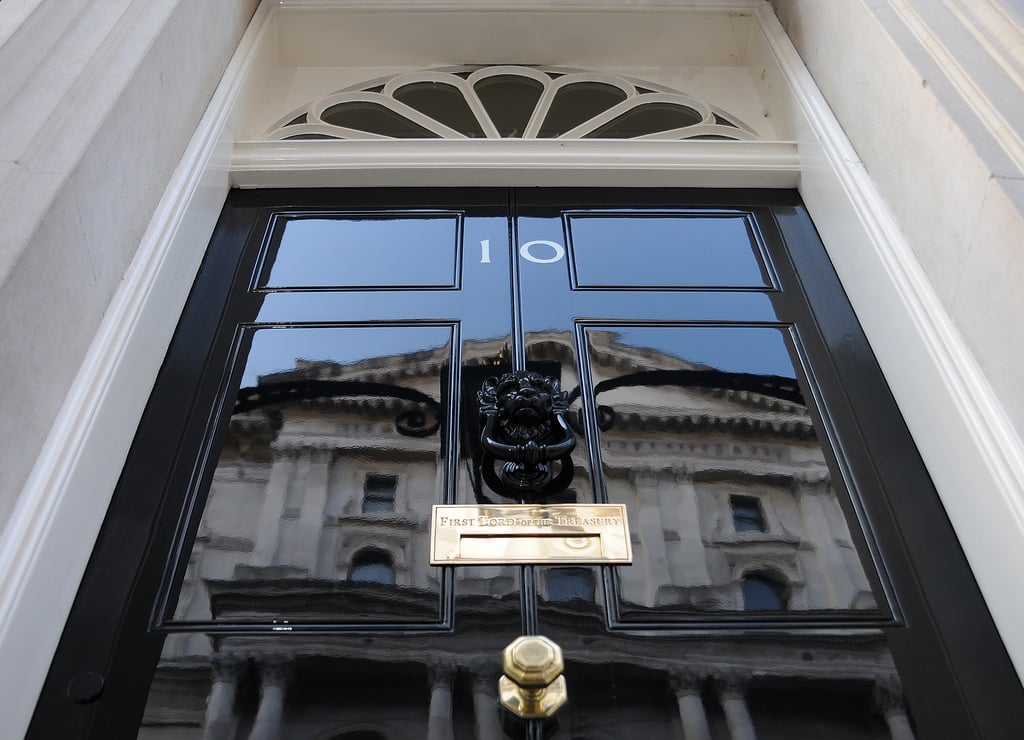
The eminence of the lion’s head knocker lives on today on the front door at 10 Downing Street—the home of the UK Prime Minister. Although 10 Downing does sport a doorbell, it does not work and every dignitary, celebrity, and VIP who visits the Prime Minister must pick up the lion and give the famous black door a solid rap.
With Charleston’s position as a Colonial and early American powerhouse, Charlestonians too would have wanted to project this image of strength. Indeed, a wander down one of Charleston’s storied streets is sure to bring you face to face with a bronze lion. Our Handsome Properties logo draws on this history as a symbol of strength and timelessness—qualities embodied in every home we sell.