Why Ravenel's Median Home Price Doesn't Mean What You Think It Means
October 1, 2026
October 1, 2026
As Citizen Portal reported, on July 2, 2026, the Ravenel Planning and Zoning Commission spent part of its monthly meeting on a single parcel on Landover Road. The lot measured 0.81 acres. Ravenel's Agricultural Residential zoning, the designation that covers most of the town, requires a full acre. The owner tore down a dilapidated mobile home under a town demolition permit and wanted to build a stick-built house where it had stood. The lot was nineteen hundredths of an acre short of the rule that would have allowed it without a hearing.
The commission recommended rezoning the lot to Residential-2, which only requires 0.69 acres, and forwarded it to Town Council for a vote at the end of July. The case is worth sitting with regardless of that final vote, because it shows that Ravenel's reputation as an acre-lot, low-density Lowcountry town isn't a fixed fact about the place. It's a rule being adjudicated parcel by parcel, most months, in a council chamber at 5962 Highway 165.
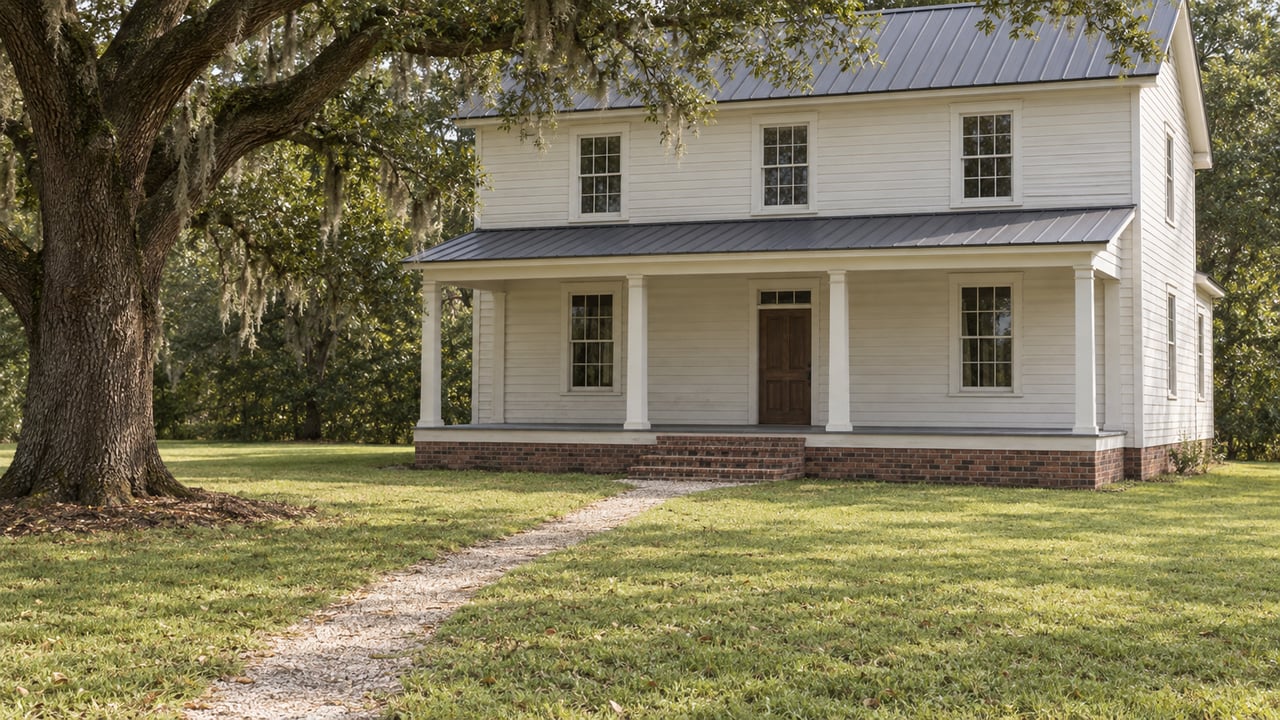
Ravenel sells on a simple premise. It sits along US 17 about 20 to 25 miles southwest of downtown Charleston, and it offers larger lots and lower prices per square foot than Mount Pleasant or West Ashley. That premise is real, and it traces back to a specific zoning mechanic: the town's Agricultural Residential designation sets a baseline of one house per acre across most of its footprint. Fewer houses per acre means less competition for the same dirt, which is a meaningful part of why an acre in Ravenel still costs less than a quarter-acre closer to the peninsula.
But that one-acre baseline is not uniform, and it is not static. It gets adjusted lot by lot, sometimes down to R-2's 0.69-acre minimum, sometimes further down to R-3 or R-4, through a formal rezoning process that runs on its own calendar independent of any single sale. Understanding that process matters more to a buyer comparing Ravenel to other Lowcountry acreage than any single price figure will.
Pull Ravenel's median home price from several sources and you will get different numbers, sometimes different price brackets. A national portal reported a July 2025 median sale price of $710,000, citing a 33 percent jump over the prior year. A separate portal's trailing twelve-month figure put the median sale price at $462,490, down 25 percent from the twelve months before that. A third source's July 2026 figure had the median list price at $410,000, down 9 percent year over year. A live September 2026 listing feed showed a median list price of $468,545 across 83 active listings.
None of these sources are wrong. They are measuring a market that sells maybe a handful of homes in any given month, which means a median can swing hundreds of thousands of dollars based on which five or ten closings happened to land in that window. In that same September 2026 feed, a 4-bedroom home in the 1956-era Ravenel Acres subdivision was listed at $329,000, and a custom home in Poplar Grove was listed at $2,594,000. Both are Ravenel addresses. Put them in the same month's listing pool and the median describes neither property.
This is not a story about a hot or cold market. It is a story about a town selling two different products under one name, and a headline median that cannot tell them apart.
| Legacy AR acreage | Planned subdivisions | |
|---|---|---|
| Example | Ravenel Acres (1956), Shilelagh Oaks Farms, Refuge at Ravenel | Hillcrest (D.R. Horton), Homecoming (True Homes), Tea Farm (Ashton Woods) |
| How density is set | Town zoning map, adjusted case by case through Planning & Zoning | Approved as a single planned development with its own density baked in |
| What you're buying | An acre or more, often no HOA, sometimes well and septic | New construction on a smaller footprint, community amenities |
| Why price varies | Depends on the exact acreage and current zoning designation of that parcel | Depends on builder, phase, and floor plan within the development |
Tea Farm alone illustrates the scale difference. The development spans roughly 3,000 annexed acres, but only about 709 of those acres are slated for use, since most of the tract is wetlands that will stay preserved. Homecoming, built by True Homes, has amenities like a pool, pickleball, and trails. Hillcrest, built by D.R. Horton, sits far enough out that some of its listings market proximity to Edisto Beach and Johns Island rather than to downtown Ravenel.
None of these communities are rezoning acre by acre in a public hearing. They arrived as finished plans. The legacy acreage stock is a different animal entirely, and it is the one actually running through the town's monthly zoning process in 2026.
Citizen Portal reported that, at its June 4 meeting, the Planning and Zoning Commission reviewed seven separate map amendments in a single session, all clustered along Savannah Highway and Ellington School Road. One request sought to subdivide a two-acre parcel into four half-acre lots. Staff recommended a lower-density R-1 designation based on the town's future land use map; commissioners pushed back, asking whether R-3 would better fit the proposed subdivision. Three one-acre parcels on the same road were recommended for rezoning from Agricultural Residential to R-3 to allow either subdivision or mobile-home park uses. And a 0.99-acre parcel at 5577 Highway 165, where the applicant hoped to place a manufactured home, drew a staff recommendation for R-2 over the R-3 requested.
Several parcels and requests drew different recommendations in the same meeting, based on exact acreage and site context rather than any blanket policy.
Citizen Portal reported that, at the June 30 Town Council meeting, members debated the same Ellington School Road cluster, deferred one contested R-3 request, and accepted the amended R-2 request for 5577 Highway 165 on first reading, conditioned on demolishing the existing dwelling before permitting. Councilman Cochran recused himself from a parcel where he had a personal interest. The mayor reminded the room more than once that members were voting on the specific zoning requests in front of them, not on any larger plan for what the corridor would eventually look like. According to Citizen Portal, by August 6, a separate parcel at 5568 Highway 165 was recommended for R-4, a jump from the R-3 the applicant had originally sought, on a 3-1 vote.
Each of these is a small, individually reasonable decision. Stacked together across a single summer, they describe a town whose acre-lot baseline is being renegotiated in public, a few tenths of an acre at a time.
This isn't new. ABC News 4 reported that in early 2024, the Tumbleston Trust proposed rezoning 99 acres along Drayton Street from Ravenel's standard one house per acre down to one house per 0.23 acres, to build a 120-home development called Pasture at FarrField. More than 400 residents signed a petition opposing the change, citing concerns that the surrounding properties, which rely on well water, couldn't support the septic load that many new homes would bring. The Post and Courier reported that Town Council responded by passing a moratorium on any subdivision of five lots or more while the town carried out a five-year review of its comprehensive plan, even as several thousand acres, including the Tea Farm tract, had already been annexed under existing rules.
The moratorium applied to subdivisions of five lots or more. Parcel-by-parcel rezoning requests continued through Planning and Zoning on the first Thursday of the month, the same process that handled the lot at 5577 Highway 165, the three one-acre parcels on Ellington School Road, and the undersized lot on Landover Road. That continuing sequence is the kind of pattern a headline median price will never register.
Ravenel's underlying appeal hasn't changed. An acre still costs less there than it does closer to the peninsula, and that gap is unlikely to close overnight. What has changed is how much weight a single median price figure can bear. The number moves because the town is, quite literally, two different zoning regimes operating under one name, and because the volume of monthly sales is thin enough that a single luxury infill closing or a single new-construction phase can swing the median by six figures. The more durable number is the acreage and the zoning line attached to the specific parcel in front of you, and that's a number worth asking for before the median ever enters the conversation.
If you're weighing acreage in Ravenel against another Lowcountry option, Handsome Properties can walk the zoning history on a specific parcel with you before you write an offer.
This article is general information, not legal, tax or financial advice. Consult a qualified professional about your situation.


Transforms property buying and selling into a thoughtful, curated, and highly personalized experience, expertly tailored to Charleston’s luxury, historic, and exclusive real estate markets.